A) allow for the measurement of GDP.
B) allow consumers to know what kinds of prices to expect in the future.
C) allow for the comparison of dollar figures from different points in time.
D) allow for the comparison of dollar figures from the same point in time.
F) None of the above
Correct Answer

verified
Correct Answer
verified
B) False
Correct Answer
verified
Correct Answer
verified
A) The consumer price index will decrease relatively more than will the GDP deflator.
B) The consumer price index and the GDP deflator will decrease by the same amount.
C) The consumer price index will decrease relatively less than will the GDP deflator.
D) One cannot generalize about the decrease in the consumer price index relative to the decrease in the GDP deflator.
F) A) and D)
Correct Answer
verified
Correct Answer
verified
A) CPI in year 1 =
B) CPI in year 1 =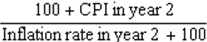
C) CPI in year 1 =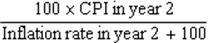
D) CPI in year 1 =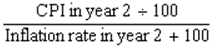
F) A) and C)
Correct Answer
verified
Correct Answer
verified
A) -3 percent.
B) 0.75 percent.
C) 3 percent.
D) 11 percent.
F) A) and B)
Correct Answer
verified
Correct Answer
verified
A) the dollar value of savings increased at 5 percent, and the purchasing power of savings increased at 2 percent.
B) the dollar value of savings increased at 5 percent, and the purchasing power of savings increased at 8 percent.
C) the dollar value of savings increased at 8 percent, and the purchasing power of savings increased at 2 percent.
D) the dollar value of savings increased at 8 percent, and the purchasing power of savings increased at 5 percent.
F) None of the above
Correct Answer
verified
Correct Answer
verified
B) False
Correct Answer
verified
Correct Answer
verified
A) prices of goods and services do not change in the same proportion from year to year.
B) consumers are slow to adjust their buying patterns from year to year in response to price changes.
C) consumers are eager to buy new products as they are introduced, despite their lack of full information about the quality of those products until they buy and use them.
D) All of the above are correct.
F) A) and D)
Correct Answer
verified
Correct Answer
verified
B) False
Correct Answer
verified
Correct Answer
verified
A) increased from 2004 to 2005 and increased from 2005 to 2006.
B) increased from 2004 to 2005 and decreased from 2005 to 2006.
C) decreased from 2004 to 2005 and increased from 2005 to 2006.
D) decreased from 2004 to 2005 and decreased from 2005 to 2006.
F) A) and D)
Correct Answer
verified
Correct Answer
verified
A) 91.6.
B) 95.2.
C) 105.0.
D) 109.2.
F) B) and C)
Correct Answer
verified
Correct Answer
verified
A) the U.S. inflation rate as measured by the GDP deflator was higher than that measured by the CPI, and the difference was explained by rapidly rising prices of goods exported by the U.S.
B) the U.S. inflation rate as measured by the CPI was higher than that measured by the GDP deflator, and the difference was explained by rapidly rising prices of goods exported by the U.S.
C) the U.S. inflation rate as measured by the GDP deflator was higher than that measured by the CPI, and the difference was explained by rapidly rising oil prices.
D) the U.S. inflation rate as measured by the CPI was higher than that measured by the GDP deflator, and the difference was explained by rapidly rising oil prices.
F) None of the above
Correct Answer
verified
Correct Answer
verified
A) increases, so the CPI overstates the change in the cost of living if the quality change is not accounted for.
B) increases, so the CPI understates the change in the cost of living if the quality change is not accounted for.
C) decreases, so the CPI overstates the change in the cost of living if the quality change is not accounted for.
D) decreases, so the CPI understates the change in the cost of living if the quality change is not accounted for.
F) A) and C)
Correct Answer
verified
Correct Answer
verified
A) the inflation rate and the consumer price index.
B) the inflation rate and the GDP deflator.
C) the GDP deflator and the consumer price index.
D) the cost of living index and nominal GDP.
F) A) and D)
Correct Answer
verified
Correct Answer
verified
A) given year divided by the price of the basket in the base year, then multiplied by 100.
B) given year divided by the price of the basket in the previous year, then multiplied by 100.
C) base year divided by the price of the basket in the given year, then multiplied by 100.
D) previous year divided by the price of the basket in the given year, then multiplied by 100.
F) C) and D)
Correct Answer
verified
Correct Answer
verified
A) rises from $0.80 to $1.00 while the price of a loaf of bread rises from $2.00 to $2.50.
B) falls from $0.90 to $0.72 while the price of a loaf of bread falls from $2.00 to $1.60.
C) remains constant, as does the price of a loaf of bread.
D) None of the above serves as an example of how the substitution bias arises.
F) A) and C)
Correct Answer
verified
Correct Answer
verified
B) False
Correct Answer
verified
Correct Answer
verified
B) False
Correct Answer
verified
Correct Answer
verified
A) There is no relationship between inflation and interest rates.
B) The interest rate is determined by the rate of inflation.
C) In order to fully understand inflation, we need to know how to correct for the effects of interest rates.
D) In order to fully understand interest rates, we need to know how to correct for the effects of inflation.
F) A) and C)
Correct Answer
verified
Correct Answer
verified
B) False
Correct Answer
verified
Correct Answer
verified
Showing 361 - 380 of 420
Related Exams