Filters
Question type

Study Flashcards

The equilibrium constant, KP, has a value of 6.5 × 10⁻⁴ at 308 K for the reaction of nitrogen monoxide with chlorine. 2NO(g) + Cl2(g) The equilibrium constant, K<sub>P</sub>, has a value of 6.5 × 10<sup>-4</sup> at 308 K for the reaction of nitrogen monoxide with chlorine. 2NO(g)  + Cl<sub>2</sub>(g)    2NOCl(g)  What is the value of K<sub>c</sub>? (R = 0.08206 L • atm/K • mol)  A)  2.5 × 10<sup>-7</sup> B)  6.5 × 10<sup>-4</sup> C)  1.6 × 10<sup>-2</sup> D)  1.7 E)  None of these choices is correct. 2NOCl(g) What is the value of Kc? (R = 0.08206 L • atm/K • mol)


A) 2.5 × 10⁻⁷
B) 6.5 × 10⁻⁴
C) 1.6 × 10⁻²
D) 1.7
E) None of these choices is correct.

F) A) and B)
G) A) and C)

Correct Answer

verifed

verified

When the substances in the equation below are at equilibrium, at pressure, P, and temperature, T, the equilibrium can be shifted to favor the products by CuO(s) + H2(g) When the substances in the equation below are at equilibrium, at pressure, P, and temperature, T, the equilibrium can be shifted to favor the products by CuO(s)  + H<sub>2</sub>(g)    H<sub>2</sub>O(g)  + Cu(s)  ΔHº<sub>rxn</sub> = -2.0 kJ/mol A)  increasing the pressure by means of a moving piston at constant T. B)  increasing the pressure by adding an inert gas such as nitrogen. C)  decreasing the temperature. D)  allowing some gases to escape at constant P and T. E)  adding a more copper. H2O(g) + Cu(s) ΔHºrxn = -2.0 kJ/mol


A) increasing the pressure by means of a moving piston at constant T.
B) increasing the pressure by adding an inert gas such as nitrogen.
C) decreasing the temperature.
D) allowing some gases to escape at constant P and T.
E) adding a more copper.

F) C) and D)
G) A) and B)

Correct Answer

verifed

verified

A 6.0-L vessel was found to contain 1.0 mol BrCl3, 2.0 mol Br2 and 6.0 mol Cl2 at equilibrium. What is the equilibrium constant, Kc, for this equilibrium mixture for the reaction 2BrCl3(g) A 6.0-L vessel was found to contain 1.0 mol BrCl<sub>3</sub>, 2.0 mol Br<sub>2</sub> and 6.0 mol Cl<sub>2 </sub>at equilibrium. What is the equilibrium constant, K<sub>c</sub>, for this equilibrium mixture for the reaction 2BrCl<sub>3</sub>(g)    Br<sub>2</sub>(g)  + 3Cl<sub>2</sub>(g) ? A)  0.014 B)  108 C)  18 D)  12 E)  432 Br2(g) + 3Cl2(g) ?


A) 0.014
B) 108
C) 18
D) 12
E) 432

F) A) and C)
G) A) and D)

Correct Answer

verifed

verified

Suppose 15.00 g of solid ammonium hydrogen sulfide is introduced into a 500.-mL flask at 25°C, the flask is sealed, and the system is allowed to reach equilibrium. What is the partial pressure of ammonia in this flask if KP = 0.108 at 25°C for the following reaction? NH4HS(s) Suppose 15.00 g of solid ammonium hydrogen sulfide is introduced into a 500.-mL flask at 25°C, the flask is sealed, and the system is allowed to reach equilibrium. What is the partial pressure of ammonia in this flask if K<sub>P</sub> = 0.108 at 25°C for the following reaction? NH<sub>4</sub>HS(s)    NH<sub>3</sub>(g)  + H<sub>2</sub>S(g)  A)  0.657 atm B)  1.25 atm C)  0.329 atm D)  14.4 atm E)  2.50 atm NH3(g) + H2S(g)


A) 0.657 atm
B) 1.25 atm
C) 0.329 atm
D) 14.4 atm
E) 2.50 atm

F) A) and B)
G) A) and C)

Correct Answer

verifed

verified

If one starts with pure NO2(g) at a pressure of 0.500 atm, the total pressure inside the reaction vessel when 2NO2(g) If one starts with pure NO<sub>2</sub>(g)  at a pressure of 0.500 atm, the total pressure inside the reaction vessel when 2NO<sub>2</sub>(g)    2NO(g)  + O<sub>2</sub>(g)  reaches equilibrium is 0.674 atm. What is the equilibrium partial pressure of NO<sub>2</sub>? A)  0.152 atm B)  0.174 atm C)  0.200 atm D)  0.326 atm E)  0.500 atm 2NO(g) + O2(g) reaches equilibrium is 0.674 atm. What is the equilibrium partial pressure of NO2?


A) 0.152 atm
B) 0.174 atm
C) 0.200 atm
D) 0.326 atm
E) 0.500 atm

F) A) and D)
G) A) and B)

Correct Answer

verifed

verified

Consider the equilibrium reaction: N2O4(g) Consider the equilibrium reaction: N<sub>2</sub>O<sub>4</sub>(g)    2NO<sub>2</sub>(g)  Which of the following correctly describes the relationship between K<sub>c</sub> and K<sub>P</sub> for the reaction? A)  K<sub>P</sub> = K<sub>c</sub> B)  K<sub>P</sub> = RT × K<sub>c</sub> C)  K<sub>P</sub> = (RT × K<sub>c</sub> ) <sup>-1</sup> D)  K<sub>P</sub> = K<sub>c</sub>/RT E)  K<sub>P</sub> = RT/K<sub>c</sub> 2NO2(g) Which of the following correctly describes the relationship between Kc and KP for the reaction?


A) KP = Kc
B) KP = RT × Kc
C) KP = (RT × Kc ) -1
D) KP = Kc/RT
E) KP = RT/Kc

F) B) and D)
G) B) and C)

Correct Answer

verifed

verified

B

Find the temperature at which KP = 42.0 for the reaction H2(g) + I2(g) Find the temperature at which K<sub>P</sub> = 42.0 for the reaction H<sub>2</sub>(g)  + I<sub>2</sub>(g)    2HI(g) . [Given: at 25°C, for H<sub>2</sub>(g) , ΔH°<sub>f</sub> = 0, S° = 131.0 J/mol • K; for I<sub>2</sub>(g) , ΔH°<sub>f</sub> = 62.26 kJ/mol, S° = 260.6 J/mol • K; for HI(g) , ΔH°<sub>f</sub> = 25.9 kJ/mol, S° = 206.3 J/mol • K; assume that ΔH° and ΔS° are independent of temperature.] A)  1040 K B)  168 K C)  539 K D)  1400 K E)  34,200 K 2HI(g) . [Given: at 25°C, for H2(g) , ΔH°f = 0, S° = 131.0 J/mol • K; for I2(g) , ΔH°f = 62.26 kJ/mol, S° = 260.6 J/mol • K; for HI(g) , ΔH°f = 25.9 kJ/mol, S° = 206.3 J/mol • K; assume that ΔH° and ΔS° are independent of temperature.]


A) 1040 K
B) 168 K
C) 539 K
D) 1400 K
E) 34,200 K

F) A) and C)
G) A) and D)

Correct Answer

verifed

verified

A

Suppose 75.0 g of PCl5(g) is introduced into an evacuated 3.00-L vessel and allowed to reach equilibrium at 250ºC. PCl5(g) Suppose 75.0 g of PCl<sub>5</sub>(g)  is introduced into an evacuated 3.00-L vessel and allowed to reach equilibrium at 250ºC. PCl<sub>5</sub>(g)    PCl<sub>3</sub>(g)  + Cl<sub>2</sub>(g)  If K<sub>P</sub> = 1.80 for this reaction, what is the total pressure inside the vessel at equilibrium? (R = 0.0821 atm • L/mol • K)  A)  2.88 atm B)  2.28 atm C)  4.54 atm D)  7.43 atm E)  9.69 atm PCl3(g) + Cl2(g) If KP = 1.80 for this reaction, what is the total pressure inside the vessel at equilibrium? (R = 0.0821 atm • L/mol • K)


A) 2.88 atm
B) 2.28 atm
C) 4.54 atm
D) 7.43 atm
E) 9.69 atm

F) A) and B)
G) A) and C)

Correct Answer

verifed

verified

a. State Le Châtelier's principle. b. The following reaction is at equilibrium in a closed container: 2Fe(OH)3(s) a. State Le Châtelier's principle. b. The following reaction is at equilibrium in a closed container: 2Fe(OH)<sub>3</sub>(s)   Fe<sub>2</sub>O<sub>3</sub>(s) + 3H<sub>2</sub>O(g); ΔH°<sub>rxn </sub>> 0 What effects, if any, will the following actions have on the position of equilibrium? In each case, state the direction of any shift in equilibrium, and give your reasons in one sentence. (i) adding more Fe(OH)<sub>3</sub> (ii) raising the temperature (iii) adding a more water vapor Fe2O3(s) + 3H2O(g); ΔH°rxn > 0 What effects, if any, will the following actions have on the position of equilibrium? In each case, state the direction of any shift in equilibrium, and give your reasons in one sentence. (i) adding more Fe(OH)3 (ii) raising the temperature (iii) adding a more water vapor

Correct Answer

verifed

verified

a. If a stress is applied to a system at...

View Answer

Hydrogen iodide decomposes according to the equation 2HI(g) Hydrogen iodide decomposes according to the equation 2HI(g)    H<sub>2</sub>(g)  + I<sub>2</sub>(g) , for which K<sub>c</sub> = 0.0156 at 400ºC. Suppose 0.550 mol HI is injected into a 2.00-L reaction vessel at 400ºC. What is the concentration of HI at equilibrium? A)  0.138 M B)  0.220 M C)  0.550 M D)  0.275 M E)  0.0275 M H2(g) + I2(g) , for which Kc = 0.0156 at 400ºC. Suppose 0.550 mol HI is injected into a 2.00-L reaction vessel at 400ºC. What is the concentration of HI at equilibrium?


A) 0.138 M
B) 0.220 M
C) 0.550 M
D) 0.275 M
E) 0.0275 M

F) A) and E)
G) A) and B)

Correct Answer

verifed

verified

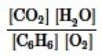
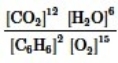
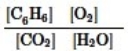
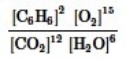
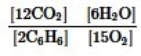
Which is the correct equilibrium constant expression for the following reaction? 2C6H6(g) + 15O2(g) Which is the correct equilibrium constant expression for the following reaction? 2C<sub>6</sub>H<sub>6</sub>(g)  + 15O<sub>2</sub>(g)    12CO<sub>2</sub>(g)  + 6H<sub>2</sub>O(g)  A)    B)    C)    D)    E)   12CO2(g) + 6H2O(g)


A) Which is the correct equilibrium constant expression for the following reaction? 2C<sub>6</sub>H<sub>6</sub>(g)  + 15O<sub>2</sub>(g)    12CO<sub>2</sub>(g)  + 6H<sub>2</sub>O(g)  A)    B)    C)    D)    E)
B) Which is the correct equilibrium constant expression for the following reaction? 2C<sub>6</sub>H<sub>6</sub>(g)  + 15O<sub>2</sub>(g)    12CO<sub>2</sub>(g)  + 6H<sub>2</sub>O(g)  A)    B)    C)    D)    E)
C) Which is the correct equilibrium constant expression for the following reaction? 2C<sub>6</sub>H<sub>6</sub>(g)  + 15O<sub>2</sub>(g)    12CO<sub>2</sub>(g)  + 6H<sub>2</sub>O(g)  A)    B)    C)    D)    E)
D) Which is the correct equilibrium constant expression for the following reaction? 2C<sub>6</sub>H<sub>6</sub>(g)  + 15O<sub>2</sub>(g)    12CO<sub>2</sub>(g)  + 6H<sub>2</sub>O(g)  A)    B)    C)    D)    E)
E) Which is the correct equilibrium constant expression for the following reaction? 2C<sub>6</sub>H<sub>6</sub>(g)  + 15O<sub>2</sub>(g)    12CO<sub>2</sub>(g)  + 6H<sub>2</sub>O(g)  A)    B)    C)    D)    E)

F) C) and E)
G) B) and D)

Correct Answer

verifed

verified

B

Iron(III) oxide can be reduced by carbon monoxide. Fe2O3(s) + 3CO(g) Iron(III)  oxide can be reduced by carbon monoxide. Fe<sub>2</sub>O<sub>3</sub>(s)  + 3CO(g)    2Fe(s)  + 3CO<sub>2</sub>(g)  Use the following thermodynamic data at 298 K to determine the equilibrium constant at this temperature. (R = 8.314 J/K • mol)    A)  7.0 × 10<sup>-6</sup> B)  1.3 × 10<sup>-3</sup> C)  2.2 × 10<sup>4</sup> D)  1.4 × 10<sup>5</sup> E)  > 2.0 × 10<sup>5</sup> 2Fe(s) + 3CO2(g) Use the following thermodynamic data at 298 K to determine the equilibrium constant at this temperature. (R = 8.314 J/K • mol) Iron(III)  oxide can be reduced by carbon monoxide. Fe<sub>2</sub>O<sub>3</sub>(s)  + 3CO(g)    2Fe(s)  + 3CO<sub>2</sub>(g)  Use the following thermodynamic data at 298 K to determine the equilibrium constant at this temperature. (R = 8.314 J/K • mol)    A)  7.0 × 10<sup>-6</sup> B)  1.3 × 10<sup>-3</sup> C)  2.2 × 10<sup>4</sup> D)  1.4 × 10<sup>5</sup> E)  > 2.0 × 10<sup>5</sup>


A) 7.0 × 10⁻⁶
B) 1.3 × 10⁻³
C) 2.2 × 10⁴
D) 1.4 × 10⁵
E) > 2.0 × 10⁵

F) B) and E)
G) All of the above

Correct Answer

verifed

verified

There are guidelines to help write equilibrium constants.

A) True
B) False

Correct Answer

verifed

verified

In the gas phase, methyl isonitrile (CH3NC) isomerizes to acetonitrile (CH3CN) , H3C-N≡C(g) In the gas phase, methyl isonitrile (CH<sub>3</sub>NC)  isomerizes to acetonitrile (CH<sub>3</sub>CN) , H<sub>3</sub>C-N≡C(g)    H<sub>3</sub>C-C≡N(g)  With ΔH° = -89.5 kJ/mol and ΔG° = - 73.8 kJ/mol at 25°C. Find the equilibrium constant for this reaction at 100°C. A)  1.68 × 10<sup>-10</sup> B)  5.96 × 10<sup>9</sup> C)  2.16 × 10<sup>10</sup> D)  4.63 × 10<sup>-11</sup> E)  8.64 × 10<sup>12</sup> H3C-C≡N(g) With ΔH° = -89.5 kJ/mol and ΔG° = - 73.8 kJ/mol at 25°C. Find the equilibrium constant for this reaction at 100°C.


A) 1.68 × 10⁻¹⁰
B) 5.96 × 10⁹
C) 2.16 × 10¹⁰
D) 4.63 × 10⁻¹¹
E) 8.64 × 10¹²

F) A) and E)
G) C) and D)

Correct Answer

verifed

verified

Stearic acid, nature's most common fatty acid, dimerizes when dissolved in hexane: 2C17H35COOH Stearic acid, nature's most common fatty acid, dimerizes when dissolved in hexane: 2C<sub>17</sub>H<sub>35</sub>COOH   (C<sub>17</sub>H<sub>35</sub>COOH) <sub>2</sub>; ΔH°<sub>rxn</sub> = -172 kJ/mol The equilibrium constant for this reaction at 28°C is 2.9 × 10<sup>3</sup>. Estimate the equilibrium constant at 38°C. (R = 8.314 J/K• mol)  A)  4.7 × 10<sup>5</sup> B)  2.6 × 10<sup>4</sup> C)  1.9 × 10<sup>3</sup> D)  3.2 × 10<sup>2</sup> E)  18 (C17H35COOH) 2; ΔH°rxn = -172 kJ/mol The equilibrium constant for this reaction at 28°C is 2.9 × 10³. Estimate the equilibrium constant at 38°C. (R = 8.314 J/K• mol)


A) 4.7 × 10⁵
B) 2.6 × 10⁴
C) 1.9 × 10³
D) 3.2 × 10²
E) 18

F) C) and E)
G) A) and B)

Correct Answer

verifed

verified

For the endothermic reaction A2(g) For the endothermic reaction A<sub>2</sub>(g)    2A(g) , a snapshot of an equilibrium mixture of A(g)  and A<sub>2</sub>(g)  may look as follows. (Each circle represents 1.0 mol of A atoms, and the volume of the box is 1.0 L.)    What is the equilibrium constant K<sub>c</sub> for this reaction at 298 K? (R = 0.08206 L • atm/K • mol)  A)  0.19 B)  0.67 C)  1.3 D)  2.7 E)  5.3 2A(g) , a snapshot of an equilibrium mixture of A(g) and A2(g) may look as follows. (Each circle represents 1.0 mol of A atoms, and the volume of the box is 1.0 L.) For the endothermic reaction A<sub>2</sub>(g)    2A(g) , a snapshot of an equilibrium mixture of A(g)  and A<sub>2</sub>(g)  may look as follows. (Each circle represents 1.0 mol of A atoms, and the volume of the box is 1.0 L.)    What is the equilibrium constant K<sub>c</sub> for this reaction at 298 K? (R = 0.08206 L • atm/K • mol)  A)  0.19 B)  0.67 C)  1.3 D)  2.7 E)  5.3 What is the equilibrium constant Kc for this reaction at 298 K? (R = 0.08206 L • atm/K • mol)


A) 0.19
B) 0.67
C) 1.3
D) 2.7
E) 5.3

F) A) and C)
G) B) and C)

Correct Answer

verifed

verified

Solid ammonium hydrogen sulfide is introduced into a 2.00-L flask, and the flask is sealed. If this solid decomposes according to the equation NH4HS(s) Solid ammonium hydrogen sulfide is introduced into a 2.00-L flask, and the flask is sealed. If this solid decomposes according to the equation NH<sub>4</sub>HS(s)    NH<sub>3</sub>(g)  + H<sub>2</sub>S(g) , K<sub>P</sub> = 0.108 at 25°C, What is the minimum mass of ammonium hydrogen sulfide that must be present in the flask initially if equilibrium is to be established at 25°C? (R = 0.08206 L • atm/K • mol)  A)  0.917 g B)  1.37 g C)  2.74 g D)  0.581 g E)  0.452 g NH3(g) + H2S(g) , KP = 0.108 at 25°C, What is the minimum mass of ammonium hydrogen sulfide that must be present in the flask initially if equilibrium is to be established at 25°C? (R = 0.08206 L • atm/K • mol)


A) 0.917 g
B) 1.37 g
C) 2.74 g
D) 0.581 g
E) 0.452 g

F) A) and B)
G) B) and D)

Correct Answer

verifed

verified

What is the free energy change, ΔG°, for the equilibrium between hydrogen iodide, hydrogen, and iodine at 453°C? (R = 8.314 J/K• mol) 2HI(g) What is the free energy change, ΔG°, for the equilibrium between hydrogen iodide, hydrogen, and iodine at 453°C? (R = 8.314 J/K• mol)  2HI(g)    H<sub>2</sub>(g)  + I<sub>2</sub>(g) K<sub>c</sub> = 0.020 at T = 453°C A)  6.4 kJ/mol B)  8.8 kJ/mol C)  15 kJ/mol D)  19 kJ/mol E)  24 kJ/mol H2(g) + I2(g) Kc = 0.020 at T = 453°C


A) 6.4 kJ/mol
B) 8.8 kJ/mol
C) 15 kJ/mol
D) 19 kJ/mol
E) 24 kJ/mol

F) All of the above
G) D) and E)

Correct Answer

verifed

verified

For the following reaction at equilibrium in a reaction vessel, which one of these changes would cause the I2 concentration to increase? 2NOI(g) For the following reaction at equilibrium in a reaction vessel, which one of these changes would cause the I<sub>2</sub> concentration to increase? 2NOI(g)    2NO(g)  + I<sub>2</sub>(g) , ΔHº<sub>rxn </sub>= 45.3 kJ/mol A)  Add more NOI B)  Add more NO C)  Increase the pressure D)  Compress the gas mixture into a smaller volume E)  Decrease the temperature 2NO(g) + I2(g) , ΔHºrxn = 45.3 kJ/mol


A) Add more NOI
B) Add more NO
C) Increase the pressure
D) Compress the gas mixture into a smaller volume
E) Decrease the temperature

F) D) and E)
G) None of the above

Correct Answer

verifed

verified

When the following reaction is at equilibrium, which relationship is always true? 2NOCl(g) When the following reaction is at equilibrium, which relationship is always true? 2NOCl(g)    2NO(g)  + Cl<sub>2</sub>(g)  A)  [NO] [Cl<sub>2</sub>] = [NOCl] B)  [NO]<sup>2</sup> [Cl<sub>2</sub>] = [NOCl]<sup>2</sup> C)  [NOCl] = [NO] D)  2[NO] = [Cl<sub>2</sub>] E)  [NO]<sup>2</sup> [Cl<sub>2</sub>] = K<sub>c</sub>[NOCl]<sup>2</sup> 2NO(g) + Cl2(g)


A) [NO] [Cl2] = [NOCl]
B) [NO]2 [Cl2] = [NOCl]2
C) [NOCl] = [NO]
D) 2[NO] = [Cl2]
E) [NO]2 [Cl2] = Kc[NOCl]2

F) A) and E)
G) A) and B)

Correct Answer

verifed

verified

Showing 1 - 20 of 146

Related Exams

Show Answer